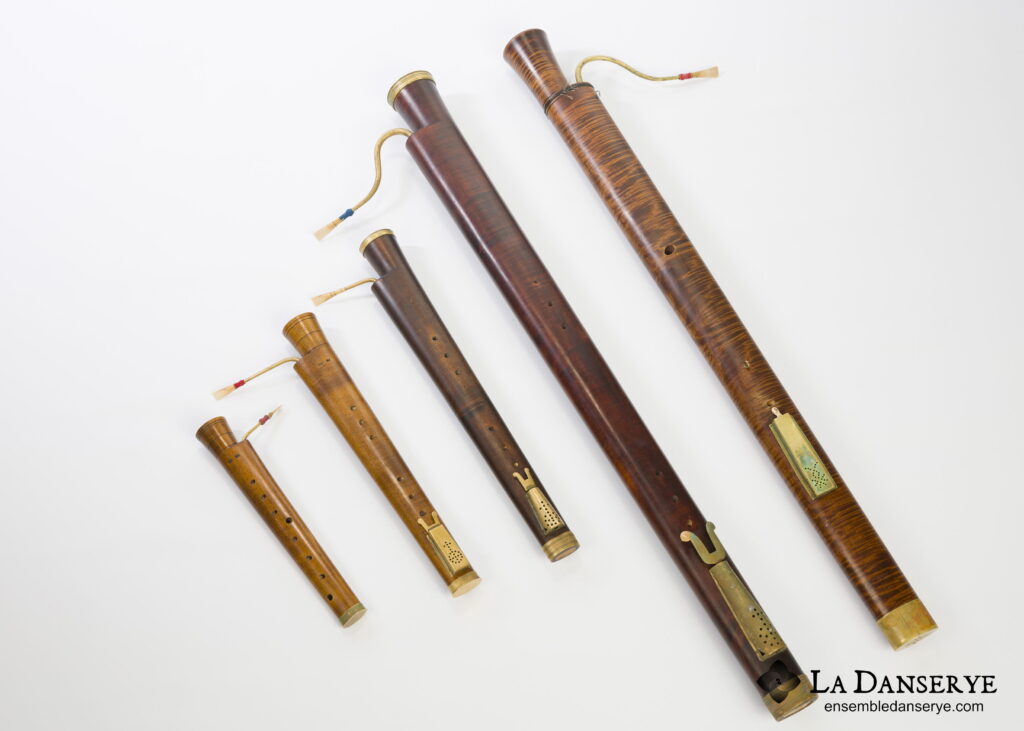
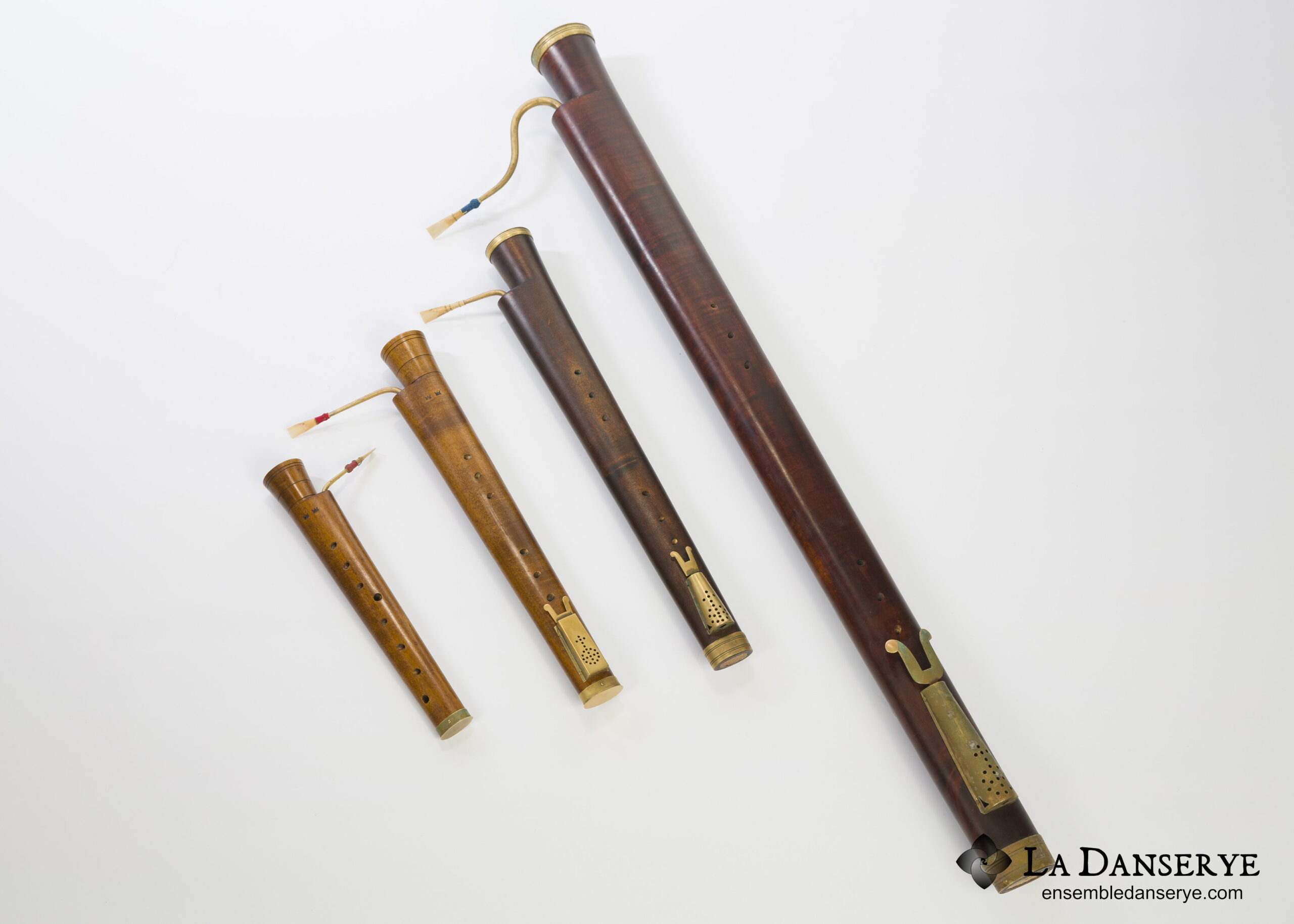
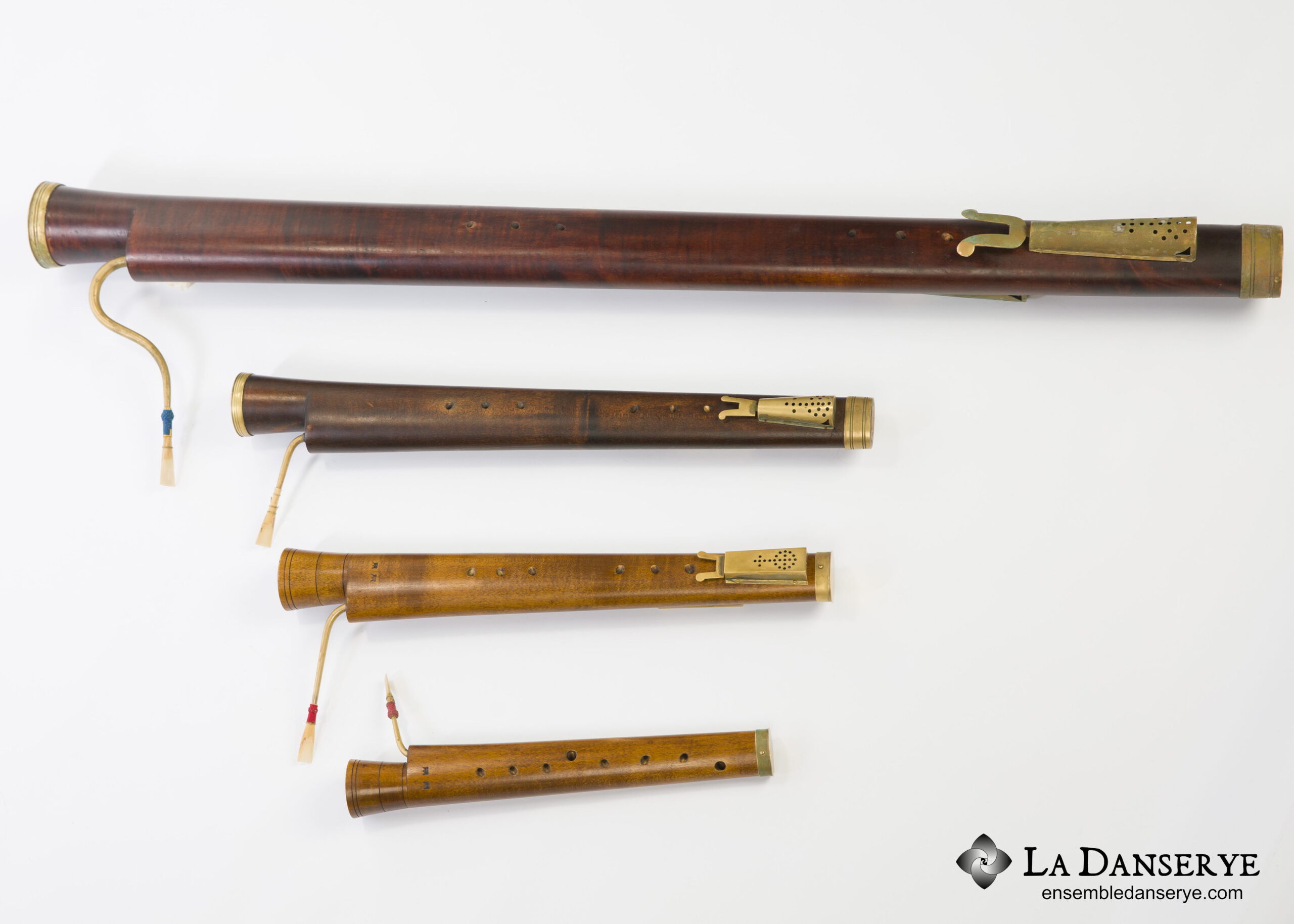
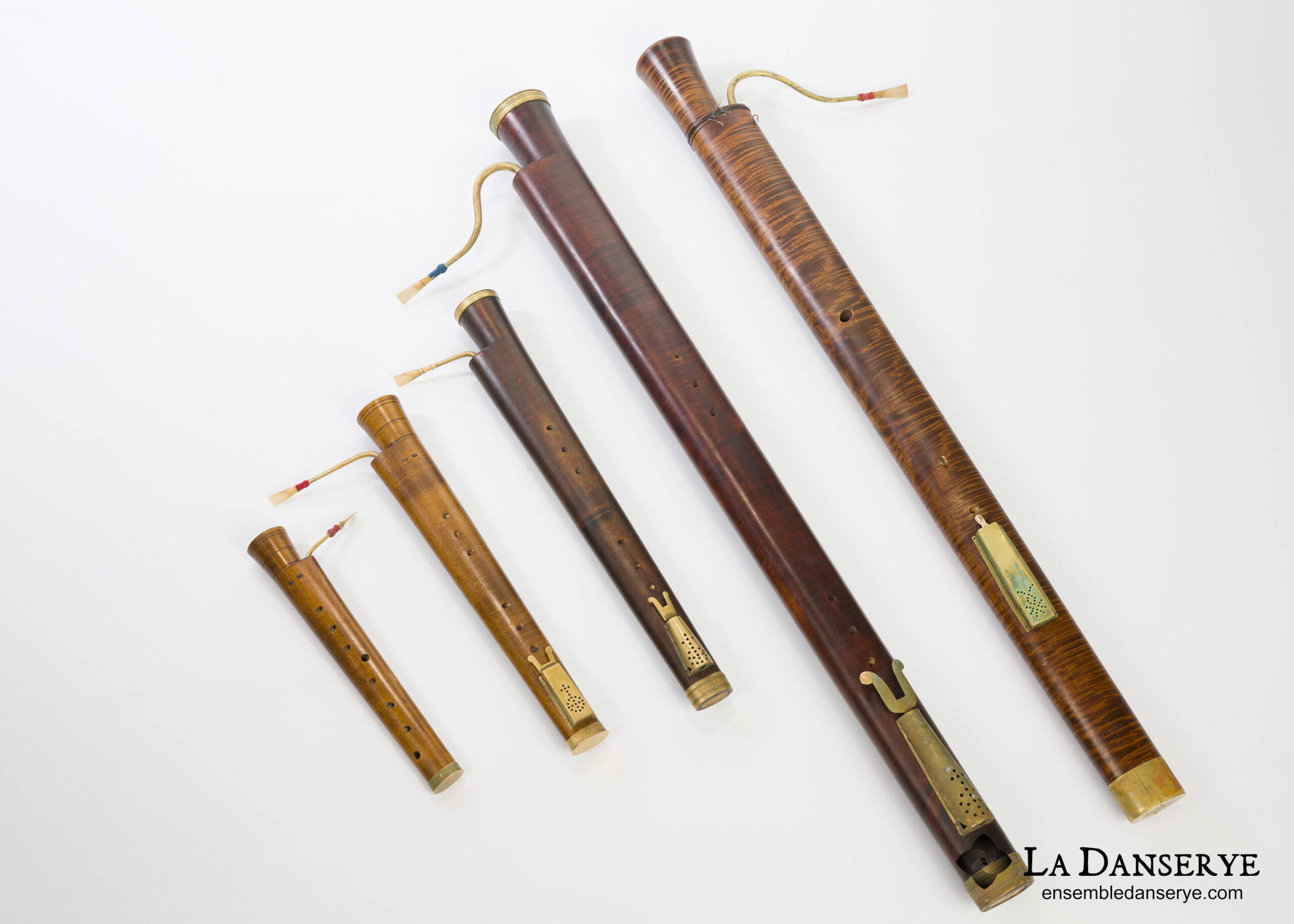
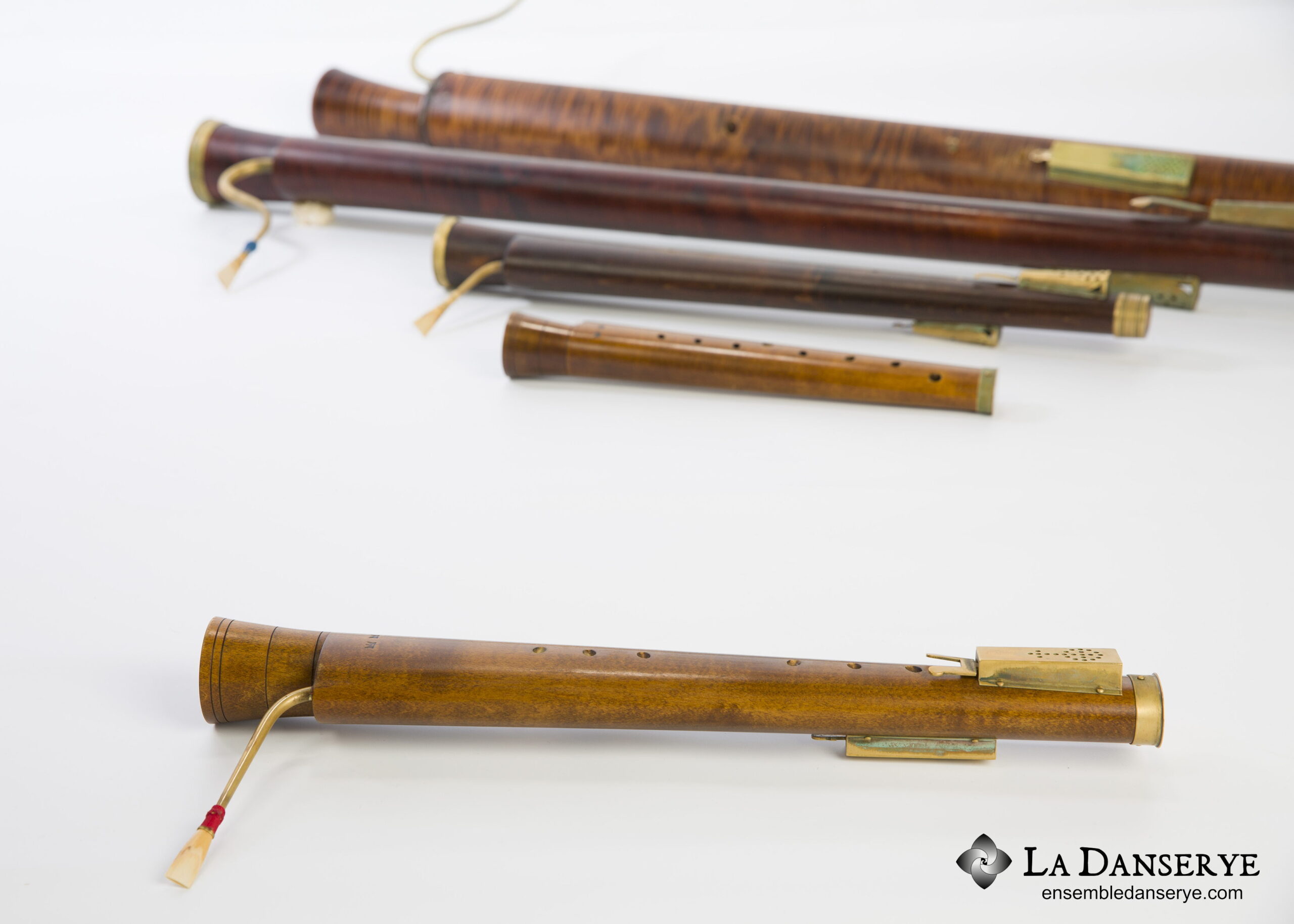
The bassoon is the direct predecessor of today’s modern bassoon. It is a double reed instrument, composed of a double bore that joins at the bottom of the instrument, forming a V shape. In this way, it folds over itself, doubling its length within the same space, which is why, despite being relatively short, it can produce very low sounds.
A mouth instrument, round and concave, about a yard long and as thick as an arm, with little difference, which has different holes where the air passes through, and with the fingers, the differences of musical composition and their sounds are formed. (…) It was called bassoon because it imitates the low point, or low octave of music. Diccionario de autoridades, 1724.
Plate from Syntagma Musicum II (Michael Praetorius, 1619) showing a family of bassoons and small bassoons.
Among the wind instruments of the Renaissance, the bassoon is the most important. This is because it was an essential part of the Music Chapels of Cathedrals and large Churches, supporting the bass. So much so that the minstrel who played the bassoon could be considered an additional singer of the chapel in terms of salary. The instrument emerged in the mid-16th century as an evolution of the low shawms, which were unmanageable due to their large size. The bassoon was indispensable and had functions both to accompany plainchant and organ singing (polyphony), sometimes completely substituting the bass voice due to the lack of singers with this register. Thus, the choir was rarely left “a cappella,” which means this practice, very common today, would not be truly “historical” when interpreting sacred compositions of the Renaissance (e.g., Victoria or Guerrero). Like all instruments of the time, an entire family of sizes was quickly built, with the smaller ones called small bassoons or little bassoons, instruments that covered tenor, alto, and soprano ranges, and which were very successful in the 17th century, being used in many compositions as independent choirs in the polychoral music of that time. The bassoon lasted until the dawn of the 20th century, always linked to the music chapels of cathedral institutions, being one of the wind instruments that has endured the longest over time without major modifications, even coexisting with its successor: the bassoon.
Apart from what we might call its “church” function, the bassoon was also used as a solo instrument, especially by composers linked to the Venetian school of the late 16th and early 17th centuries. Particular importance is given to the Selma family, musicians and builders, of whom Bartolomé de Selma y Salaverde wrote virtuosic works for this instrument in his “Canzoni, fantasi et correnti (Venice, 1638)“.